
The History of the Pumi Breed
Origins of the Pumi
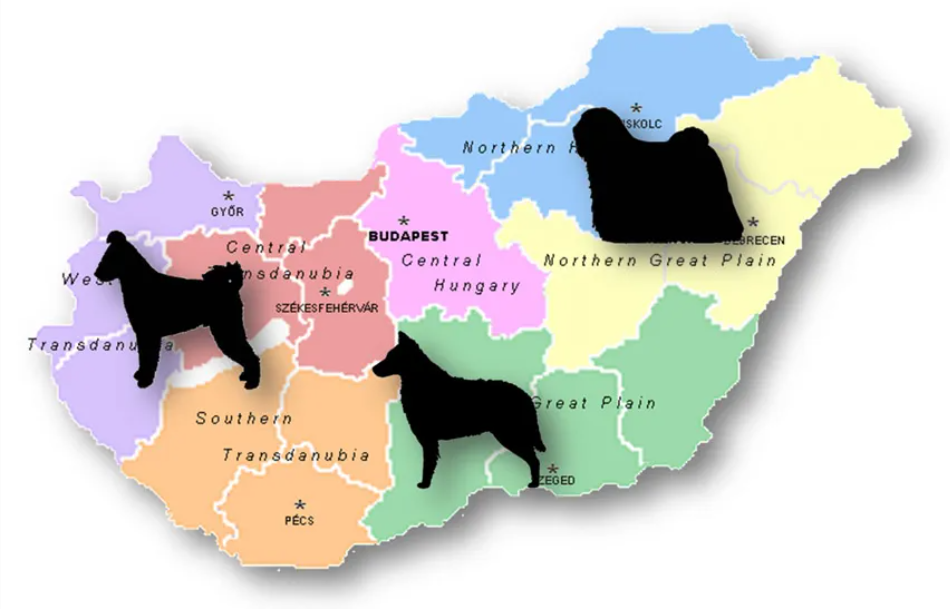
The Pumi (and its related breeds the Puli and Mudi) are ancient Hungarian herding breeds believed to be derived from the ancestral “Hungarian Herding Dog”. Around 800 AD, this breed migrated from the Ural Mountains and Siberia to settle in the Carpathian Basin alongside the Magyars (Hungarians). There was no true standard written for this generic Hungarian Herding Dog but examples of Puli and Pumi-like animals can be seen in artwork going back to the 17th and 18th centuries. The first recorded use of the “Pumi” name was used in 1815 to describe a sheepdog. Pumi type dogs are most associated with the western Transdanubian hilly region of Hungary, while the Puli type dog was most commonly found in Eastern Hungary, in the Puszta (flat plains). The Mudi breed was most associated with the southern plains of Hungary. There was often confusion during the 1800’s when referring to the Pumi and Puli dogs, as the words were often used interchangeably and with different descriptors for each depending on the region.
Dr. Emil Raisits (a Professor at the Hungarian University of Veterinary Medicine) developed the Pumi, Puli, and Mudi standards in the early 1900s, starting with the Puli. They developed a breeding program to solidify the breed type and the Puli became a “fashionable” dog to own, while Pumi were left to continue as working dogs. In 1921, Emil believed the Pumi needed to be developed into their own breed, separate from the Puli, as opposed to being a regional variety. Originally referred to as the “sheep dog terrier”, the Pumi attitude is considered to be lively and energetic. The most obvious separations of breed type between Pumi, Puli, and Mudi, can be found in the descriptions of their ears, coat, and tails. Pumi dogs were eventually recognized as having ⅔ erect ears, a curly coat, and a curly tail as major hallmarks. The Pumi standard was approved by the FCI in 1935. (Photo Credit)
Pumi in the USA
While there were some Pumi imported into the USA prior to 1998, most development of the breed here occurred following that year. In 2001 the Pumi joined the AKC Foundation Stock Service, which is a program the American Kennel Club offers for tracking breedings and registrations of dogs prior to gaining full recognition. The Hungarian Pumi Club of America was formed in 2005 and was able to help steer the breed towards accomplishing the AKC requirements for acceptance. Pumi entered the Miscellaneous class of AKC Open Shows in 2011. In July 2016, Pumi entered the AKC Herding Group and was allowed to compete at all AKC conformation shows. (Read more about the specific dogs that impacted the breed here)
Herding Style
These herding breeds played an integral role in the lives of their shepherds and communities. Pumi were developed in a region where most livestock owners lacked their own pastures for their animals. This developed a need for a quick, agile herding dog that was capable of driving large flocks of animals through narrow-mountain passes to pasture and back to the homestead on a regular basis. These dogs needed to be able to keep their stock together without allowing the animals to wander into other properties. They had limited room to work the livestock, so large looping herding styles would not be effective in the mountainous environment. This led to the creation of a herding dog that was unafraid of tough livestock, working in close quarters, and was capable of handling the difficult terrain.
Pumi have historically been used for herding Hungarian Grey Cattle, Mangalica Pigs, and Racka Sheep. All three types of animals have strong temperaments and required a dog that was able to convince them to move by any means necessary, often using loud barks and the occasional nip. These are breed traits that are still dominant in our dogs today and must be carefully directed into appropriate behaviors for home life. This is an agile dog with a loud voice that is able to work independently of the shepherd due to a need to make quick decisions while working on top of livestock. To expect a quiet, calm dog that will relax on your couch without receiving a mental and physical workout would be to do a disservice to your Pumi.