How We Raise Our Puppies
Nixie Pumi Puppies
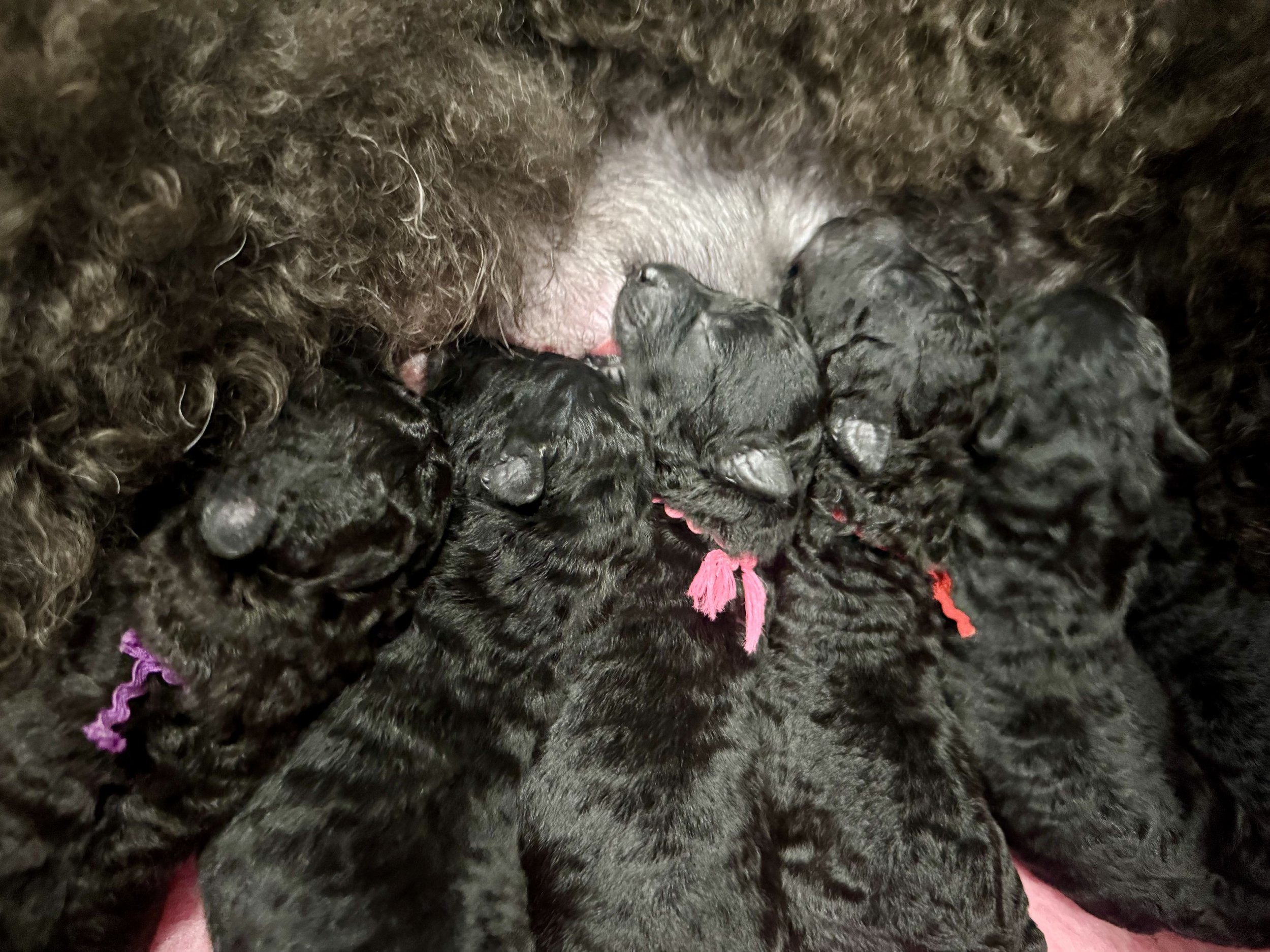
What we are most proud of in our program is how we raise our puppies. We use every minute of your puppy's first 8 weeks to help prepare them for real life in our “human world”. The first 12 weeks are considered the “critical socialization period” in puppies and we do everything in our power to set them up for success. For the first three weeks we sleep in the whelping room with our mother and her litter, so we are always available to assist with any concerns and help support our mothers as needed. We follow Puppy Culture Protocol in our program—this is a puppy lead program that is designed to train and socialize them in an age-appropriate manner as they grow. We tailor this program as needed to our individual puppies and litters. We do Volhard temperament testing on all our puppies to help give us a greater understanding of how our puppies react to new people and situations. Our puppies also go through an Early Neurological Stimulation program designed to help create healthy and well-adjusted adult dogs.
All our puppies are raised in our home. We do not have any type of kennel facility, so your new puppy is exposed daily to the traditional household hustle and bustle. They become used to the noise of our adult animals, the roar of the vacuum cleaner, and the drama of visiting guests. We have other adult dogs, a cat, and young children that we are able to safely expose puppies to. We have no way of knowing where puppies will be placed until approximately 8 weeks of age, so all puppies in the litter are raised equivalently. Our show dogs and our pet dogs receive the same exceptional care across the board. We normally only breed if we are planning on keeping back a puppy for our own program, so you can be assured that we hold every puppy to the same high standards that we expect with our own keeper puppy. We are happy to share pictures of our home and set-up as well as arrange meet and greets with families that live close enough to visit. If we are travelling at a show in your area, you are invited to join us at our event.
Nixie Pumi are well known for being successful, beautiful, and in possession of phenomenal temperaments. We accomplish this through a variety of ways and hold our puppies to exceptionally high standards. We are here to offer lifetime support for you and your puppy for many years. Please reach out at any time so that we can offer you advice as needed. We raise each puppy like our own, so even if everything is going perfect, please keep us up to date. We are never bothered when owners reach out and are so excited to add you to our extended Pumi family.
Puppy Culture
What really is “Puppy Culture”? If you have been search the web for reputable breeders, you may have see this phrase posted on many different pages. Puppy Culture is a program that lays out a socialization and training protocol to simplify things in a step by step process for breeders. Most responsible breeders are doing portions of Puppy Culture even if they aren’t calling it that, as it is predominantly a well presented puppy raising guide. Why is Puppy Culture so important then? Puppy Culture has information for you, too! There are phenomenal resources on their website for you to take advantage of so that you can continue this program into your own home. The first 12 weeks of your puppy’s life is the most important for socialization, so you are responsible for the 8-12 stage. Puppy Culture is a tool to assist you in raising a well adapted, adult dog. Get started with the Puppy Culture Owners Guide. Not sure where to look next? Take the quiz! As a part of this program, we provide a head start for all puppies on loose-leash walking, potty training, and crate training.
As our litter accomplishes different tasks, we will post updates for you to follow. It’s so much fun to watch their growth in just a few short weeks! If you are ready to get started at home to prepare, the best bundle for you to get can be found here. We do not receive any kick back for these promotions, we just want to set you and your family up for success with your new puppy. This program is designed to be continued through 12 weeks of age. After 12 weeks, we don’t call it socialization anymore, it’s called training!
Volhard Temperament Testing
What is the Volhard Temperament Test? We do Volhard Temperament tests at approximately 49 days of age. This is when the puppy brain is considered neurologically complete. There are ten tests that are scored separately from one another. Testing should occur in a neutral location that the puppy is not familiar with. The tests are:
Social Attraction
Following
Restraint
Social Dominance
Elevation
Retrieving
Touch Sensitivity
Sound Sensitivity
Sight Sensitivity
Stability
The test begins with the breeder placing the puppy about four feet away from the examiner and leaving the area. The examiner will kneel down and try to call the puppy towards them. This is used to gauge Social Attraction. For Following, the tester will stand up and slowly walk away while encouraging the puppy to follow them away from the direction that the breeder went to exit the room. Restraint: the tester will try to gently roll the puppy over onto its back. They should not apply much pressure but make note of how resistant. For Social Dominance, the tester will let the puppy sit or stand and gently pet the puppy from their head down its back to the tail. They should be sitting beside the puppy and not placing any body pressure upon the dog. Elevation Dominance: the examiner will hold the puppy off the ground for approximately 30 seconds. Retrieving: the tester will get the puppy’s attention and gently toss a crumpled up ball of paper a few feet in front of the puppy. Touch sensitivity": The tester will apply light pressure to the puppy’s foot and monitor reaction. Sound Sensitivity: The puppy is placed in the center of the testing area and someone outside the testing area should make a loud, sharp noise (such as dropping a dog food bowl). Sight Sensitivity: the tester will drag a towel on a string across the floor about two feet from the puppy. And finally Stability: the examiner will open an umbrella approximately 5 feet away from the puppy and gently place the object on the ground.
The puppy is scored on each exercise with a rating of 1-6. Most puppies will have a mix of scores ranging anywhere from 1-6. The ideal puppy has a test score where most fall into the 3 and 4 range. Puppies with a lot of scores in the 1-2 range are generally better suited for an experienced home. Those with lots of 5-6’s are very independent and like to make their own decisions. We help use these scores to place our puppies in the home best suited for their temperament.
Early Neurological Stimulation
Early Neurological Stimulation is a puppy handling program that takes place between days 3-16 of a puppy’s life. It is designed to kickstart a puppy’s neurological system by stimulating various portions of their body. This program is not performed on puppies that are stressed or experiencing health concerns or lack of weight gain. More is never better with this program. In some studies puppies that were exposed to this program were more active and exploratory compared to puppies that did not experience ENS. We do the following five exercises no more than once per day with our puppies:
Tactile Stimulation: A Q-tip is rubbed gently between the puppy’s toes on any one foot for 3-5 seconds
Head Held Erect: The puppy is held upright with the head held above the tail but inline with the rest of the body, perpendicular to the floor for 3-5 seconds
Head Pointed Down: The opposite of step 2, with the head of the puppy pointed downwards with the tail above the head for 3-5 seconds
Supine Position: The puppy is held gently on its back with the muzzle facing the ceiling for 3-5 seconds
Thermal Stimulation: The puppy is placed on a damp cool towel, feet on the towel, for 3-5 seconds
Puppies that have been through an ENS program are more likely to have stronger hearts and adrenal glands, a greater tolerance to stress, and a greater resistance to disease than puppies that have not been raised with ENS protocols.