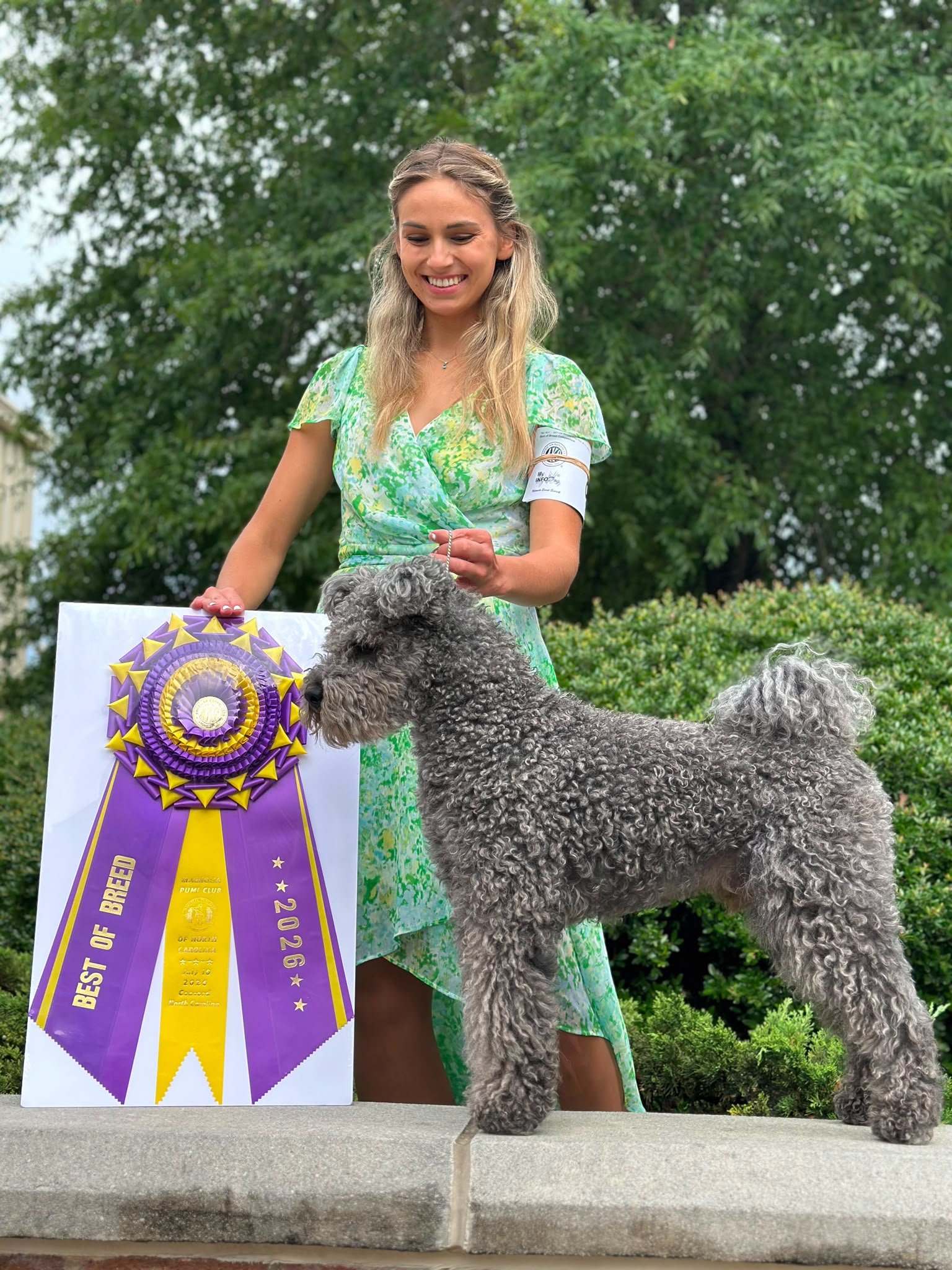
Grooming Your Pumi
Nail Trimming
We recommend trimming your puppy’s nails every 1-2 weeks. You can easily learn how to trim nails at home or you can take your puppy to the grooming salon and have the pro’s take care of it for you. At our house, we trim every week and use a dremel to grind the nails smooth. The dremel is louder, but if your puppy is comfortable with it, the dremel allows the nail to be taken shorter and does not apply a pinching feeling to the nail that some dogs dislike. If your puppy has dewclaws, don’t forget to trim those as well! How to Trim a Dog’s Nails Safely | Canine Nail Trim Tutorial
Maintaining Coat
Our recommendation for a puppy is to brush and bathe on the same day, at least once a month. As the coat starts to change to an adult coat, brush and bathe more frequently as needed. Clean coats do not mat as easily as dirty coats, so keeping their hair clean will help make your at home maintenance easier. The dirt and oils in the hair are what help the mats form quicker. You can bathe your dog up to once a week without irritating their skin. You do not have to brush your dog out every time you bathe it, but you can spot comb as needed in the high friction areas, such as underneath the front legs in the underarm area and between the rear legs, or around the face. Every time your puppy's brushed out they should then be wet down to the skin. This will cause the curls to form back up and help protect from more matting. Throughout the brushing process, we recommend using a process called “line brushing”. This means you are brushing the coat “line by line” all the way to the skin. Line Brushing Tutorial: Double Coated Breeds
As your puppy is getting used to the process, keep treats on hand to reward them. It’s often easiest to break the brushing down into 10-15 minute sections with play breaks in between. I often brush my dogs out laying on the floor and watching TV and since they don’t mind being grooming they often sleep through the process. You can groom your puppy on a grooming table or raised area if you are unable to groom them on the floor. Please be careful to make sure your puppy doesn’t get away from you when they are elevated and accidentally injure themselves. Before starting to brush, put some water in a spray bottle and lightly mist the coat. Re-mist the coat as needed depending on the time it takes you to finish brushing. The coat should have just a light coating of water.
When brushing, start with a slicker brush and work your way around the dog. Work from back to front, top to bottom. Start at the base of the tail and line brush up the back towards the neck. Then work your way from the hips down to the rear feet. Then the sides of the body from the back down towards the stomach. Then from the neck down the front legs to the feet. Roll your puppy over on its back to help brush the stomach area and between front and rear legs. Brush out the tail and then go back and do the head and face of the dog last. Please be careful brushing around sensitive areas such as the eyes, ears, nose, and sanitary area. When brushing, it helps to apply tension to the skin, just as if you were brushing a human child’s hair. When you hold the skin tight, you prevent the skin from being pulled in the same direction as the hair. The whole grooming process should be comfortable for your dog. If your dog is uncomfortable or acting as if they are in pain, please stop and message me and I will help you troubleshoot this. As your puppy will require lifelong grooming, we want this process to be as easy and stress free as possible for both of you.
Once you have gotten the slicker through the coat, follow up with the pin brush. The slicker is great for big tangles and the pin brush is a bit more comfortable to brush throughout. If your puppy is showing signs of being extremely uncomfortable with the slicker, you can start instead with the pin brush following the same pattern. The slicker is best for the highly tangled areas of the coat. After the pin brush, you will then use my poodle comb to check for tangles at the skin. If the comb will not easily slide through the coat, go back to the pin brush to detangle. The goal of the entire brushing process is to detangle, not to pull out hair. It is normal for hair to come out in the grooming process and you may need to stop multiple times to remove hair from your brush head. If you can easily get your comb through all areas of the coat, all the way down to the skin, you are finished brushing!
How long this process takes varies by the coat type and age of the dog. My heavily coated male takes about an hour to an hour and a half to brush out, while my lesser coated female takes about forty minutes to an hour. Even if you plan to have your dog groomed by a professional, you will need to provide at home maintenance for your dog unless you plan to have them very short every 6-8 weeks. Please plan on starting to take your puppy to your groomer within a month of coming home to your house. The sooner they become exposed to the salon process, the happier they will be in the long run! This first visit can be for a simple bath and brush process, or even just a nail trim!
When using a salon, please try and find a groomer that is willing to learn to groom the breed appropriately if you would like your puppy to look like a correct Pumi. The process for show dogs takes an extended amount of time and is often not feasible for most high volume or corporate style salons. This is the simplified version of my grooming routine: brush out, comb out, bathe, air-dry, scissor, done! The air-dry step of the process is often the one that causes the most difficulty for salons to accommodate, as this can take a few hours. If your pumi is blown dry, they will not look curly! A blown out pumi is not correct, as the curls are an essential part of breed type.
That being said, a healthy, clean, groomed dog is most important. Many people simply accept the blow out as part of the grooming process and will re-soak their dog at home. The salon may offer to spray the coat back down after the trim, but this is often not sufficient enough to return the coat to the proper curl. Our standard says that the curl must go all the way to the skin, and a spray bottle can often not soak the coat enough to return the curl all the way down.
Show dog owners never trim their dog when the coat is blown out, because after the curls come back the coat will look uneven. Even the most perfectly trimmed pumi coat, if groomed when blown out, will look choppy after the curls come back. The tightness of the curls varies greatly based on the part of the body the curl is on. If the dog is blown out, it is important that the owner soaks the dog back down at home to return the curl, otherwise the coat will mat more easily at the skin. It will not appear to be matted on the outside layer of the coat, but may form a felted layer underneath. The curls help prevent our dogs from matting.
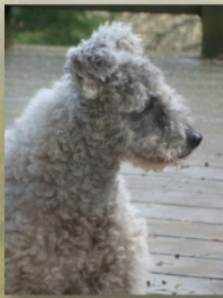
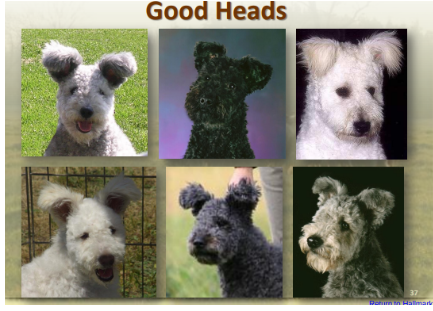
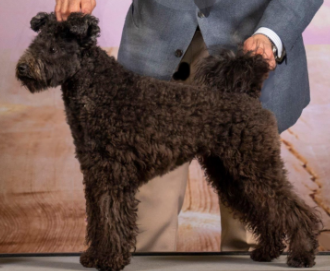
One of the hardest parts of the breed “look” for groomers to get correct is the Pumi head. If you find your groomer has sent your puppy home looking more like a “doodle” than a Pumi, you can provide them with the our “information for groomers” document. Pumi should be groomed with no discernable stop (the part of the head between the forehead and muzzle). They have a ⅔ erect ear that is NOT “tasselled” like a Bedlington, but simply trimmed to slightly longer than the ear leather.
The pumi coat is a very thick coat, so you may find that when you are bathing it takes a bit of time to soak your dog all the way to the skin. If your dog gets out of the tub, shakes, and is back to being the same color and looking almost dry, the water did not penetrate deep enough into the coat. We don’t recommend using a conditioner, but almost any shampoo will work for your dog. Shampoos targeted for rough coated breeds, like terriers, are the most popular. Currently we use the Whitman’s Three Whiskers Real McCoy shampoo. We find it smells nice and gets the coat clean without softening it too much. 3 Whiskers Real McCoy Ruff Coat Shampoo – Whitman's. We use this in a diluted form of 30:1.
For cases in which extra help is needed to remove mats from the dogs coat, a detangler may be used for spot treatment. Recommended detanglers are Cowboy Magic Detangler & Shine - All-In-One Grooming Solution – Cowboy Magic, Espana Silk Detangler SILK Natural Protein Detangler/Full Body Sheen/Protectant Spray with Sunscreen - Dog/Cat, Chris Christensen Just Divine Brushing Spray, and Chris Christensen Ice on Ice Detangling and Finishing Spray. If you do not have any of the above, a watered down human conditioner can be added to a spray bottle and used.
For Your Groomer
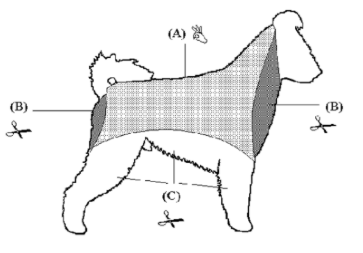
Pumi should have no discernable stop when viewed from the side. Please do not groom the Pumi with a moderate to severe stop. The head is wedge shaped, but not snipey. Pumi do not have Bedlington tasseled ears, they are simply trimmed around the ear leather. The outline of the Pumi is square and the tail should be a circle with a key hole in the middle. Below are good examples of heads and body outlines. If the coat has been well maintained by the owner, the trim looks best done first on a “dirty” coat, then bathed, with a finally finishing trim after the dog is dry. If you are not able to accommodate the natural drying time in the salon, then skip the final trim portion. If the dog’s coat has not been maintained, please shave the dog and direct the owner to more appropriate at home care.
Longer pins are better for longer coats. Bigger brush heads cover more hair at a time making for fast grooming. The exact brand of brush used is not important as long as it is of decent quality.
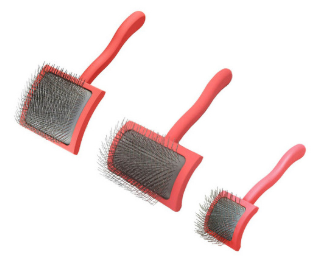
Slicker Brush: Pictured is the Chris Christensen Big G Slicker Brush. I use the medium or large size.
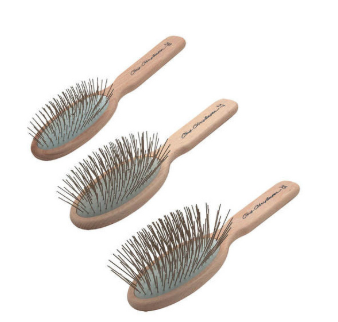
Pin Brush: Pictured is the Chris Christensen Oval Style Pin Brush. The 27 mm size is the recommended one.
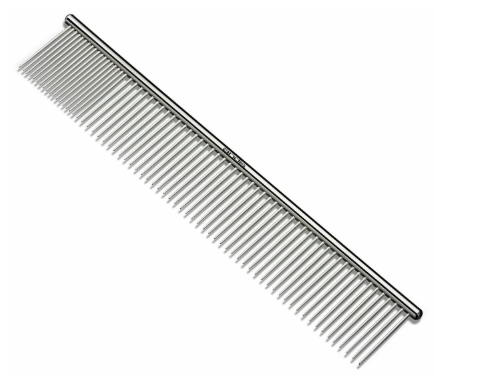
Comb: Andis 10” Finishing Comb. I like that this has Coarse and Fine options on the same comb. I use the coarse (wider) pin side first. I usually use the fine (narrow) side on the face around the eyes and mouth.
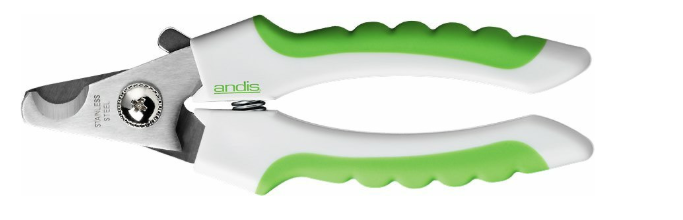
Pliers Style nail clippers: Where both blades move. The guillotine style nail clippers where only one side moves applies uneven pressure to the nail and can be less comfortable for the dog. Pictured is the Andis Nail Clipper
Grooming Supply Recommendations