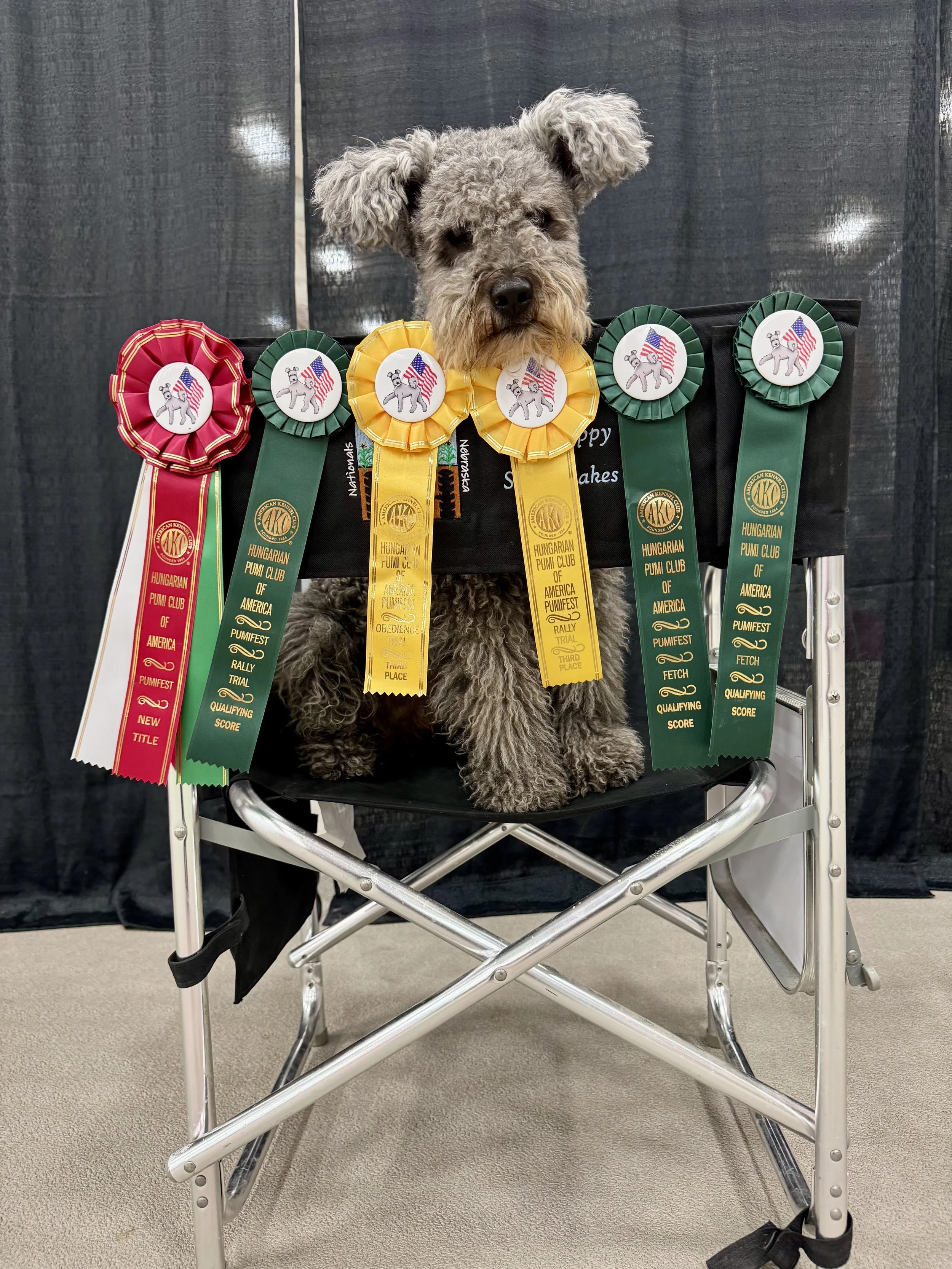
Training a Pumi
Consistency
Pumi require consistency in training from their owners. This is a breed that wants to be right and will try to anticipate what you are asking them to do. If they guess wrong, they will get annoyed with the process and discouraged. They do not handle repetition well and get bored very easily, so building drive and engagement takes time. The best way to train any puppy is to set them up for success first, where the only option they have is to make the correct choice. However, Pumi are incredibly smart dogs and have a habit of coming up with a different answer, so they will keep you on your toes when it comes to your training plan. It’s very important to remember that what is cute in an 8 week old puppy, may not be so cute in an 8 month old puppy. We want to turn our puppies into well adjusted adults.
Early Socialization and Exposure
It is imperative that your puppy be exposed to new people and situations throughout their early months with you. This means that we want to put them in new situations, but we always want to be as in control of that situation as possible. If there are too many variables out of our control, then we risk the puppy being startled by something we did not expect and were not ready to react to. We never want to force our puppy into a situation they are uncomfortable with, but neither do we want our puppies to react inappropriately when unanticipated situations arise.
Can you socialize your puppy prior to vaccinations being completed? Yes! As long as one vaccination has been received and your puppy is up to date on their most recent vaccine, we recommend socializing your puppy in public. The positive effect of long term behavior health outweighs the risk of disease. This does not mean you should take your dog to the dog park, but a trip to your local store would be considered a reasonable outing for your puppy. The first three months of your puppy’s life is the most important for socialization. AVSAB Position Statement On Puppy Socialization
Obedience Classes
We recommend that you sign your puppy up for a group obedience class that begins shortly after your puppy arrives at home. Please search for a science-based, positive reinforcement or balanced dog training center in your area. Group training classes help provide a low risk and high reward environment for your puppy and your family to learn. If you can, an AKC Star Puppy course is a great place to start, and easily transitions into a beginner obedience course aimed at earning you an AKC Canine Good Citizenship Title. While the title itself is simply fun to earn, the most important part is the wide range of necessary day-to-day skills your puppy must complete in order to accomplish it. This title is a very manageable goal for the average dog to achieve and can often be done in the course of a normal obedience class.
We highly recommend that some form of training class continues through the puppy turning one year of age. Training is not just an uphill climb and it is normal for puppies to plateau and regress between 6 months to 1 year of age. By having a consistent training class, you will have a trainer that is familiar with your dog and able to offer advice as you encounter hurdles.
Training Equipment
We like to keep things simple in our training with a six foot leash and a rolled leather collar. We do not recommend head halters (which strain the neck), no-pull front clip harnesses (which compress the chest and front legs), or prong collars (which are too much correction for a puppy). You can use a regular back clip harness for your puppy as long as they are not spending a lot of time pulling on the leash. Back clip harnesses are the same style used by sled dogs, because it gives them a lot of power down their back to pull, which is the opposite of what we want to teach our puppy.
The harness is a great option to use when around the house with your puppy. The first few months I will use a harness attached to a lightweight leash that is either connected to me or dragging behind them. This allows me to keep the puppy close enough to supervise and be under control should I need to get ahold of them quickly. (Expand later).
Crate Training
Crate training is one of the most difficult and more important things you can teach your puppy. While most people do not crate their dogs when they are older, this is a skill that can be life saving. In emergency situations, you may need to have your dog in a crate in your house or in an emergency shelter. Your dog may end up staying at an emergency vet overnight and being stressed in a crate will not help your dog heal. When travelling in the car or staying in a hotel, it’s relaxing for your puppy to have a safe and familiar place to sleep and calm down. If you have guests at your house where it would be dangerous for them to accidentally trip over your dog, we want your puppy to be safe and comfortable.
What size crate do you need? Our adult dogs fit very comfortably in a 32” wire dog crate. If you buy this size, you will want to have a divider inside to make it smaller and then expand it as your puppy grows. The ideal size is just big enough for your puppy to stand up, turn around, and lie down in. We do not want the puppy to have enough room to go to the bathroom on one side of the crate and then sleep on the other side. If the crate does not come with a divider, please purchase a smaller crate to use in the meantime.
When you first bring your puppy home, we recommend using an ex-pen for your puppy that has a crate inside it. This way your puppy is still contained within a small area, but is not stressed about being in a crate whenever you have to take your eyes off of them. They should already have a good start on crate training before they go home with you, so this transition period should be simple for them. You should start with short durations in the crate and when you leave the house, give them a Kong toy to keep them happy and distracted. When you leave, this should be a low-key event that does not work your puppy up right before you walk out the door. I recommend even while you are home, having them go in the crate with a treat, close the door for a few seconds, and let them back out. We don’t want your puppy to anticipate that every time they are in the crate that they are going to be left alone when you leave the house. I will often feed all meals in the crate for the puppy for the first few weeks, so it becomes a very positive experience for them. They learn very quickly that when the dog bowl comes out, they run right into the crate and wait! Crate Training A Puppy. When leaving your puppy alone, we recommend removing their collar, as the tag could become stuck on the crate and strangle your puppy.
We highly recommend getting your puppy a Snuggle Puppy toy to help them transition away from their littermates. This toy has both a heat pack and heart beat inside that mimics having another puppy around them. This is a training toy and not a chew toy, so if you find your puppy is doing a lot of playing with this toy, please remove the toy from them for their safety. There are batteries inside that we do not want them to chew up.
Recall Training
This is a herding breed that is often very attached to their owners, never straying far from their side during puppyhood. However, one of our leading causes of death in Pumi under one year of age is Hit by Car. Oftentimes, this attached to the hip behavior is there right up until it isn’t. You should never trust your puppy off-leash under one year of age. Usually this puppy closeness disappears suddenly between 4-8 months old and comes back again when they are older. Please do not let their puppy behavior lure you into a false sense of security. There are not many Pumi in the USA at this time and a not insignificant number of Pumi have been killed taking off after a car at a young age, having expressed no previous desire to chase, taking their unsuspecting owners by surprise. This is a tragic and avoidable situation.
Puppy Biting
Puppy biting and nipping is very common and frustrating to deal with for new owners. It is a natural instinct in all puppies, but especially so in our herding breed puppies. Pumi were bred to work very closely on livestock, nipping at the heels and barking to control the flock. Because this behavior is innate to the breed, we expect to see this behavior in all Pumi puppies at one point or another. This is not aggressive behavior, but we also do not want to encourage inappropriate biting at any point. While you can see this behavior at any point, there are some situations which can exacerbate it.
Puppies bite when they are overly excited, such as during play, but also when they become overly tired. When they are frustrated, hungry, or teething they are also more likely to start nipping at hands, feet, and clothing. If they are teething, they will want to put everything in their mouths as chewing helps relieve some of the pain of new teeth coming in. If they are bored and do not have an appropriate chewing outlet, they will resort to chewing on us instead. The nipping behavior is also triggered by fast movements, so kids running in the house or backyard, or hands playing fast around their face.
Puppies learn bite inhibition from their littermates and mother, but after 8 weeks it’s up to you to properly redirect bad behavior into good behavior. Your reaction can escalate or de-escalate the situation, so it’s important to have a reaction plan in place for the whole family when nipping behavior starts. If we can avoid any of the situations mentioned before, that’s a great place to start. Just like with toddlers, we don’t want to overstimulate our puppies or overwork them. Overwhelmed and exhausted puppies have a much smaller threshold for good behavior. When you notice your puppy is too wound up or tired, put them in their exercise pen or crate and allow them to calm down and relax. If you have kids, keep your puppy away during activities that might trigger too much excitement and bring them back out when everything has settled down.
If biting does happen, the most important thing is disengage with the puppy and whatever activity has triggered it. If you were playing with the puppy, playtime is immediately over when teeth meet skin. If you are on the floor with them, stand up. For kids, have them get up on a couch or chair out of reach of the puppy. Any attention, positive or negative, is considered a reward for the puppy as the engagement continues. With kids, it’s important that they learn to keep themselves safe and out of the way, as even though your puppy is not being aggressive, those puppy teeth still hurt! If possible, we don’t want to scream or cry out as this can also encourage the puppy. Puppies LOVE the sound of screaming kids; it’s loud and exciting, and they have no idea what the difference between happy shouting and scared shouting is. We want to teach our puppy that the bad behavior means everything they want stops immediately. When the puppy has calmed down, we can re-engage or re-direct with a break or toy, depending on what started it. How to Stop Puppy Biting: The Positive, Proven Way I Teach All My Puppies
Food Aggression
The best way to prevent food aggression is to be proactive. The worst thing to do, which is advice that has stubbornly clung around dog training circles for decades, is to repeatedly stick your hands in your puppy’s food bowl while eating or to take the bowl away entirely. There is no better way than the above to create a food aggressive puppy. If every time you ate dinner and people stuck their hands in your food or kept taking it away, you would likely also develop a protective instinct for your dinner plate.
Instead of creating a negative association with people and the puppy’s food dish, we are going to create a positive one. The best way to do this is to add a high value reward to your puppy’s food dish while eating. This way the puppy will associate people approaching them while eating and reaching towards the food bowl with a positive experience. If you are eating your dinner and someone came along and kept bringing you your favorite dessert, you would be pretty happy to see that person keep coming back.
The same concept is what we are applying to your puppy! So, as your puppy is eating, just approach slowly and toss a high value treat into their bowl. This can be a small piece of chicken or their favorite crunchy biscuit. Each puppy will value different rewards differently. Some like moist, soft treats, others like crunchy treats, and some even have weird favorites like Cheerios! We recommend having all family members help practice this, especially children.